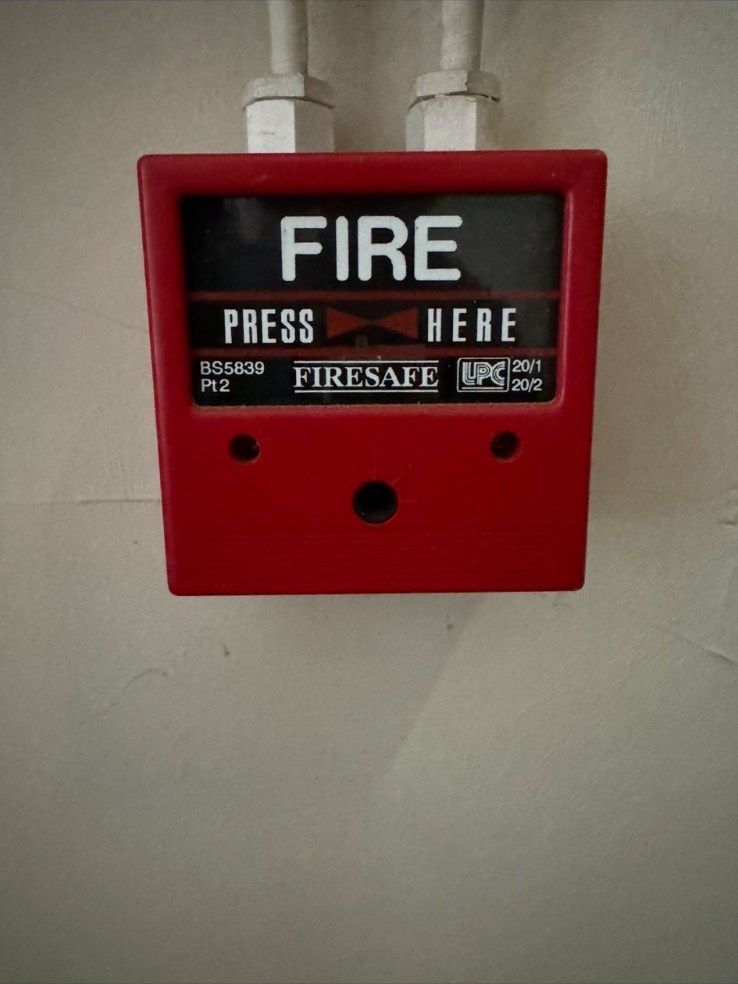
HMO Fire Alarm SystemsDesigned for Licensing &Tenant Safety
A Grade A LD2 system designed around how your HMO actually works, corridor heads where they need to be, sounders that wake people from sleeping risk, paperwork your licensing officer signs first time.
Trusted by landlords, developers & letting agents across Cardiff, Newport & Swansea.
15+
Years on the tools
BS 5839
Certified to standard
24–48h
Typical callout window
100%
Insured & DBS-checked
Service overview
HMO Fire Alarms, explained without the jargon
What it is
Specialist fire detection and alarm systems for Houses in Multiple Occupation, designed to BS 5839-6 with the grade and category dictated by the property's licensing conditions and fire risk assessment.
Who it's for
Private HMO landlords, student accommodation operators, supported housing providers, and letting agents managing licensed HMO portfolios across South Wales.
When it's needed
Before a new HMO licence application, ahead of a renewal, when adding bedrooms, after a change of use, or following an enforcement notice from the local authority.
Why professional matters
HMOs combine sleeping occupants, shared escape routes and unfamiliar layouts, the highest-risk residential category. The wrong system kills people and ends portfolios.
The cost of ignoring it
Why most failed HMO inspections fail
Risks if left unchecked
●Sounders below the 75 dB at bed-head required to wake sleeping occupants.
●Domestic interlinked detectors used where Grade A is required, with no panel and no monitored cabling.
●Detection missing from kitchens, lounges or principal habitable rooms required under LD2.
●No commissioning certificate, the system 'works' but no inspector can prove when or by whom.
Common mistakes
●Buying a system to suit a budget rather than the licence.
●Assuming the previous landlord's system is still compliant after a refurb.
●Skipping the design stage and asking the installer to 'just put a few heads in'.
●Letting a general electrician fit the system without BS 5839 competence.
Licensing officers do not negotiate. A non-compliant HMO can be served prohibition, the rent stops, and Rent Repayment Orders can apply for up to 12 months of rental income.
Our process
A clear path from enquiry to certificate
Step 1
Licensing-aware survey
We attend with your fire risk assessment in hand and confirm the grade and category required for your specific licence area.
Step 2
Design pack
Device schedule, sounder dB calculation, zoning and cause-and-effect, supplied in writing with an itemised quote.
Step 3
Installation
Cabling concealed wherever possible, communal area work scheduled around tenants, mains spurs from the landlord's supply, not a tenant meter.
Step 4
Commissioning
Dec readings taken at every bed-head, full system test, panel labelled by room, four BS 5839 certificates issued.
Step 5
Licence handover
Compliance pack formatted for direct submission to Cardiff, Newport, Swansea or your local licensing scheme.
Why clients stay with us
Specific, measurable benefits
First-time pass
Designed to the licensing scheme, not the bare minimum standard.
Tenant-friendly install
Minimal disruption, no overnight loss of detection, communal areas back in service same day.
Portfolio pricing
Per-bedroom pricing for multi-property landlords with consolidated certificates.
Built for servicing
Standardised on Hochiki/Kentec so servicing across your portfolio uses common spares.
Audit-ready paperwork
Digital certificates filed to a portal, produce them in 30 seconds when the licensing officer asks.
Insurance protection
Specification matched to insurer requirements, not just the minimum legal standard.
Technical detail
Everything that goes into a proper hmo fire alarms
HMO fire alarm requirements vary by local authority, by article 4 direction, and by individual licence conditions. The notes below reflect the schemes we work with across South Wales most often.
Cardiff additional and mandatory HMO licensing
Cardiff Council requires Grade A LD2 minimum for licensed HMOs, with category L2 for higher-risk layouts. Sounders at bed-head must achieve 75 dB. We design directly to the council's published HMO fire safety guidance.
Newport, Swansea, Bridgend and the Valleys
Schemes vary, some require LD1 in three-storey or larger HMOs. We confirm at survey and never under-specify to win a job. The design pack states exactly which clause of the scheme each device satisfies.
Sleeping risk and inter-flat compartmentation
Bedroom-by-bedroom detection, sounders sized for closed-door conditions, and where flats are involved, an interface that activates only the affected flat's sounder to avoid mass evacuation false-alarm fatigue.
Student HMOs and high-turnover lets
We supply tenant-facing 'what to do in a fire' posters keyed to your zone plan and label panels in plain English. False-alarm management plans are part of the handover.
Supported and exempt accommodation
For supported housing with mobility or learning-disability tenants we specify vibrating pads, strobes and PIR-linked cause-and-effect, and document it for the Care Inspectorate.
Article 4 areas and listed buildings
Where chasing cable is restricted we specify EN 54-25 wireless systems with documented battery replacement intervals so the listing officer and the licensing officer both sign off.
Frequently asked
Frequently asked questions
Most licensed HMOs in Cardiff require Grade A LD2 minimum. Larger or higher-risk properties may need LD1. We confirm against the council's HMO standard at survey.